Antennas
Marine 5G antenna: where to mount it and which cable to use
An outside antenna is the single biggest upgrade for internet on a boat. Mounted in the wrong place, or on the wrong cable, it can also be the most expensive way to change nothing.
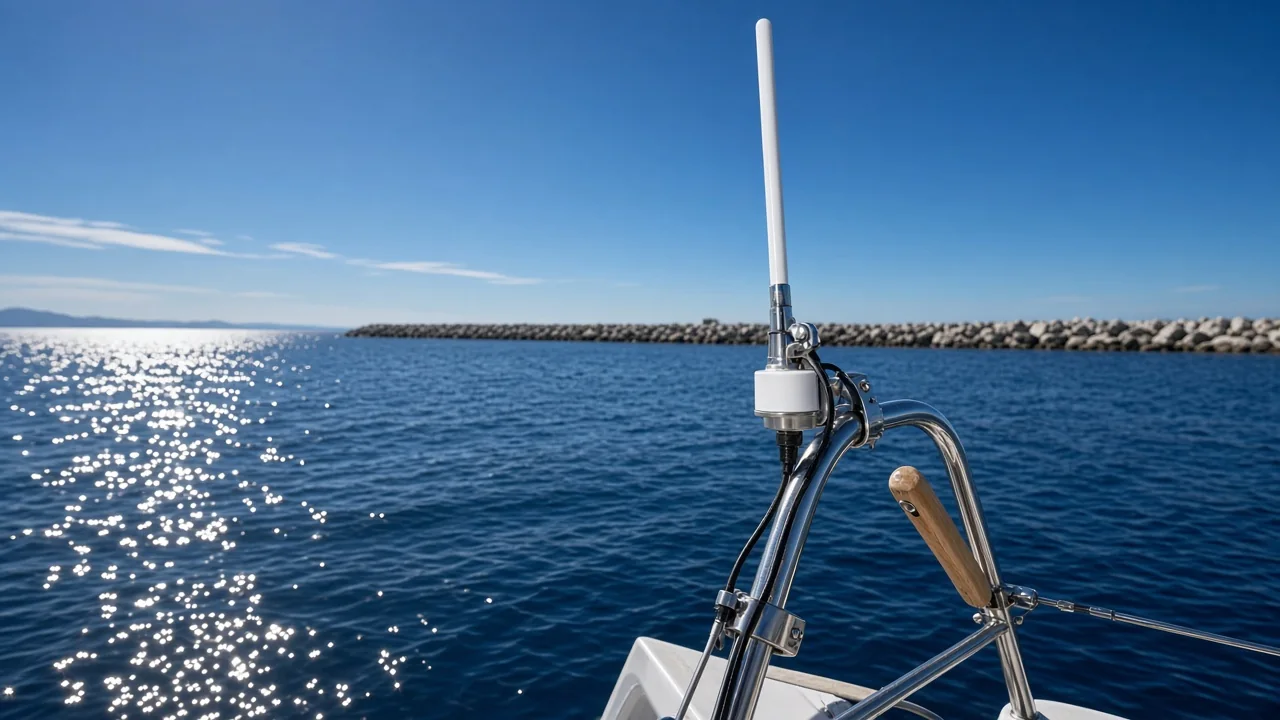
A router inside the cabin is working through fibreglass, teak, people and often a stainless sprayhood frame. Every layer costs signal. Put the antenna outside and a few metres up, and the router suddenly sees masts on shore it could not reach before. That is the whole idea. The details are where it goes right or wrong.
How high should a boat antenna be?
Higher reaches further, because the curve of the earth and the waves block less. But the gain flattens quickly. Going from cabin height to two or three metres above the deck makes a clear difference. Going from three metres to the masthead rarely does, because you need 15 to 20 metres of cable to get there and the cable eats what the height gave you.
For most sailing yachts the sweet spot is the stern arch, the pushpit or a short pole on the transom. On motor yachts it is the radar arch or the hardtop. Both are easy to reach when a connector needs attention.
Cable length and cable type
This is the part most installations get wrong. Mobile frequencies are high, and thin coax loses a lot of signal per metre at 1800, 2600 and 3500 MHz. Keep the run as short as the boat allows and use proper low-loss cable. As a rule of thumb, if you need more than 10 metres, the antenna is probably in the wrong place.
- Use the cable that matches the antenna connectors, normally SMA, so you avoid adapters.
- Seal outside connectors with self-amalgamating tape and leave a drip loop before the cable goes through the deck.
- Do not crush the cable in a hatch or run it tight around sharp edges. A kinked coax can lose more than a few extra metres would.
Keep it away from the VHF and the radar
Give the mobile antenna at least a metre of space from the VHF antenna, and never mount it in the beam of the radar scanner. Both can disturb each other, and the radar can damage the electronics in the base of the antenna over time.
One antenna or two?
4G and 5G routers use MIMO, meaning they talk to the network on two or four antenna ports at the same time. A marine antenna with two elements in one housing, like the fibreglass antenna we sell, covers two ports with one mounting point. If your router has four ports, a Y adapter can split the two cables to four. Connecting only one port works, but you give away speed.
A quick test before you drill: tape the antenna to the arch temporarily, run the cable through a hatch and compare speeds against the router alone in the saloon. Five minutes of testing has saved many owners a hole in the wrong place.
When a fixed system makes sense
If the boat is your home for the season, or you anchor away from towns most nights, a fixed router with an outside antenna is worth it. For a charter week, a portable router placed high in the cockpit is often enough. You can read more in our main guide to internet on a boat.
Frequently asked questions
Is a masthead antenna better?
Rarely. The extra height is mostly lost again in the long cable down the mast, and servicing it means going aloft. A stern arch or radar arch is usually the better compromise.
Can I use a car or motorhome roof antenna on a boat?
It will work for a while, but salt water and UV are hard on materials. A marine antenna in fibreglass with sealed connectors is built for it and lasts much longer.
Do I need a 5G antenna if my router is 5G?
Yes, the antenna needs to cover the frequencies the router uses. A 5G antenna also covers 4G, 3G and 2G, so it works everywhere the router does.